
Being a Fruit Grower’s Son Is Not Enough. Tomasz Piasecki: Today, You Have to Take Responsibility for Your Own Farm
“The Orchard Is My Life”
The farm run by Tomasz Piasecki and his parents currently covers 31 hectares, with 28 hectares planted with apple and pear trees and another 3 hectares dedicated to blueberries. Eight hectares have already been transferred to Tomasz. The varieties grown include Gala Schniga and Schnigo Red, Golden Delicious, Red Jonaprince, Idared and Szampion apples, primarily Conference and Xenia pears, and Duke and Spartan blueberries.
The yields demonstrate the scale of production. Gala apples produce approximately 70 tonnes per hectare, Red Jonaprince around 90 tonnes, pears approximately 60 tonnes, and blueberries around 10 tonnes per hectare.
– I have been involved in fruit growing since childhood. Even as a teenager, I knew this was my life and my passion. I grew up surrounded by orchard farming. The orchard is my life – says Tomasz Piasecki.
This continuity is particularly important because the award winner sees the farm as more than just a family legacy. Since taking over part of the business, he has been making his own decisions regarding new plantings, varieties, trellis structures and crop protection systems.
– I owe a great deal to my parents, but since taking over part of the farm, I have become deeply involved in investments. I personally select the tree varieties I want to plant, choose trellis structures and hail protection systems, and make the most important decisions – he emphasizes.
Precision Begins in the Orchard
At the Piasecki farm, little is left to chance. The farm uses GPS-equipped orchard tractors, GoTrack control technology, sprayers fitted with computers for precise application of crop protection products, an orchard work platform and a weather station. Fertigation is another important element, allowing fertilizers to be delivered in precisely controlled doses to individual orchard blocks.
Tomasz places particular importance on water management. All apple, pear and blueberry plots are equipped with drip irrigation systems. The irrigation system is linked to a weather station, which helps determine when plants need water and how much they require.
– Water is essential for plant growth and achieving high yields. Pear trees are particularly sensitive to water shortages. That is why I want to know not only how much water I am applying, but above all, when the plants actually need it – he explains.
However, production extends well beyond the orchard itself. The farm has eight controlled-atmosphere storage chambers, each with a capacity of 160 tonnes, equipped with CA, ULO and DCS technologies. It also operates a computer-controlled GREFA 200 sorting line, which handles fruit movement and grading according to buyers' requirements.
Quality Over Quantity
Tomasz Piasecki has a clear vision for the farm's development: the vast majority of its production is intended for the fresh fruit market. For apples and pears, his target is approximately 90% fresh-market quality fruit.
At the same time, technological development does not mean abandoning practices that reduce the use of crop protection products. The farm uses organic fertilizers, compost, humic substances and microbiological preparations. Tree training and formative pruning have been carried out since 2013, and the farm was among the first to introduce mechanical pruning. Weeds are controlled mechanically, reducing the need for herbicides.
Other measures include flower strips, nectar-producing plants, nesting boxes for mason bees, insect hotels and bird nesting boxes. Biological crop protection solutions and pheromone traps are also used throughout the orchards.
– I do not run a fully organic farm, but I use many practices that are similar to organic farming methods. I want to produce high-quality fruit while taking care of the soil, water resources and biodiversity – he points out.
Investing in Resilience
In recent years, the farm has also invested in protecting its production. Hail protection systems are already in operation across five hectares, while 13 hectares are covered by frost protection measures. Additional structures designed to support anti-hail netting are currently being installed.
– Without protection systems, we would not be able to maintain such a high level of production. Weather is now one of the greatest risks we face, so we have to be prepared for it – says the award winner.
Over the past three years, the farm has also introduced new plantings, modern technologies and autonomous solutions supporting orchard operations.
He Hesitated to Enter the Competition
Paradoxically, the man whose farm was recognized by the competition jury was initially far from convinced that he should enter.
– I lacked the courage to enter the first edition. I thought others were better than me. This time, what encouraged me most were the words of Wojtek Kot, who said that young fruit growers should enter competitions and showcase their work – Tomasz recalls.
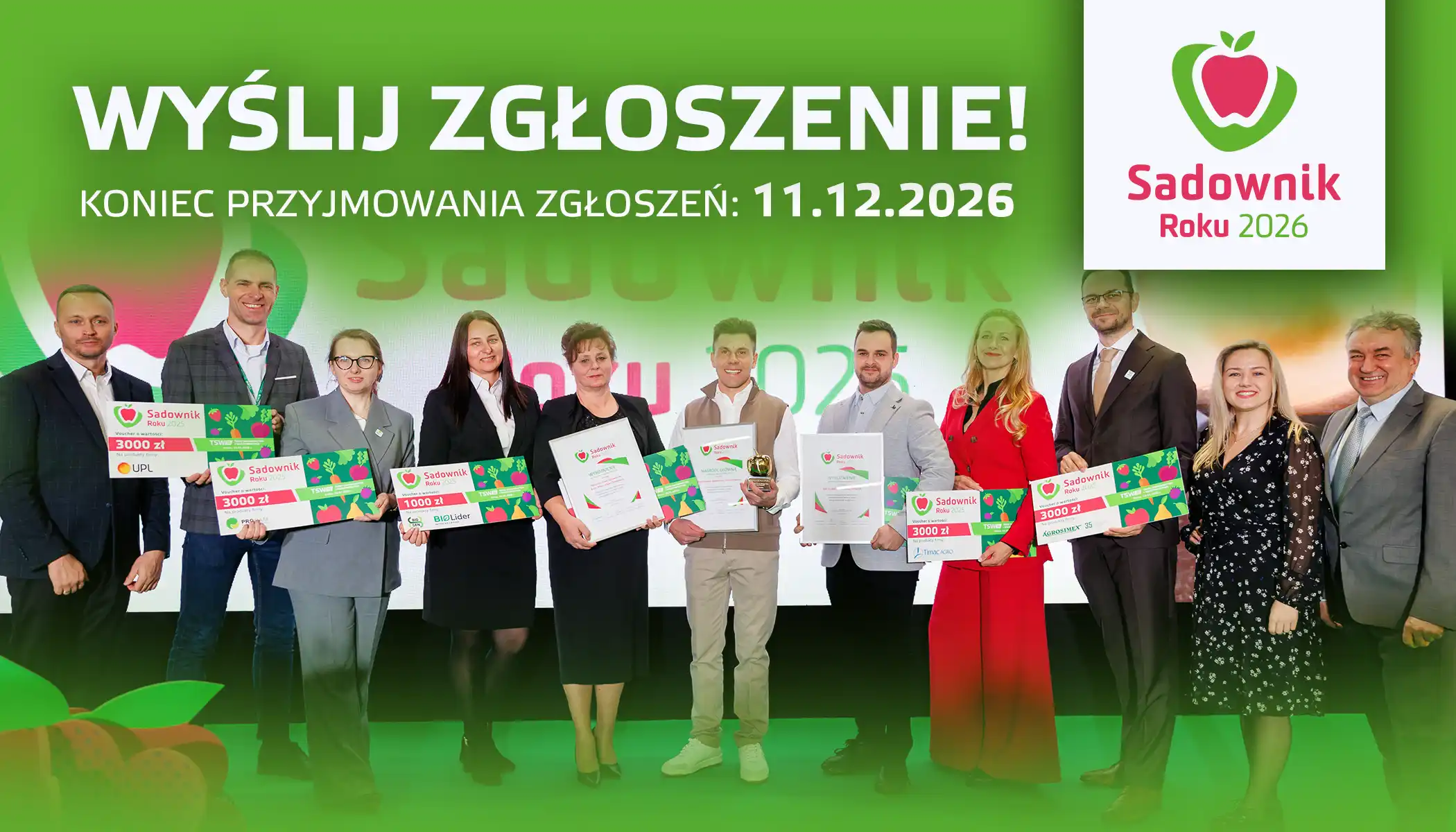
His decision proved to be a significant milestone. The title of Fruit Grower of the Year 2025 and the Golden Apple statuette were awarded during TSW. The jury recognized, among other achievements, the farm's production results, advanced technologies, crop protection and irrigation systems, and its focus on producing high-quality fresh-market fruit.
For Tomasz, however, the award is not the finish line.
– This title shows me that we are developing the farm in the right direction. It also motivates me to introduce further improvements – he says.
“Young Growers Must Show What They Can Achieve”
Tomasz Piasecki believes that the younger generation of fruit growers has a particularly important role to play today.
– We have to prove that we can face challenges and take our farms to the next level. Fewer and fewer young people want to stay in agriculture. I would like my story to show that there is still potential in this profession and that investing in a farm is worthwhile – he emphasizes.
In the coming years, he plans to further develop high-quality fruit production, increase orchard planting density and devote more attention to promoting the farm. He admits that he still struggles to find the time and motivation to establish professional social media profiles for the business.
The competition has therefore become not only an opportunity to win an award but also an incentive to present the farm to a wider audience.
It Is Worth Sharing Your Story
Tomasz Piasecki's story also answers an important question: why enter the Fruit Grower of the Year competition at all? It is about much more than winning a title. The competition provides an opportunity to tell the story of a farm, showcase investments, technologies and working methods, and exchange experiences with other producers.
The current edition of the competition is open to everyone running a fruit-growing farm in Poland. The organizers assess various aspects, including production quality, innovation, community involvement and farm management. The application includes a presentation of the farm, its achievements and future development plans, with the option to submit photographs and videos.
Today, Tomasz Piasecki has no doubts about whether entering was worthwhile.
– If someone is wondering whether to enter, I would say: give it a try. It is worth showing the work you do. Being a fruit grower means much more than simply saying, “I am a fruit grower's son.” I now truly feel that I am a fruit grower in my own right, and I take full responsibility for my farm – he concludes.
Perhaps these are precisely the stories that Polish fruit growing needs most today: farms developed step by step by people who are eager to learn, invest and take responsibility for their decisions.
Zobacz więcej
Zobacz więcej
Zobacz więcej